

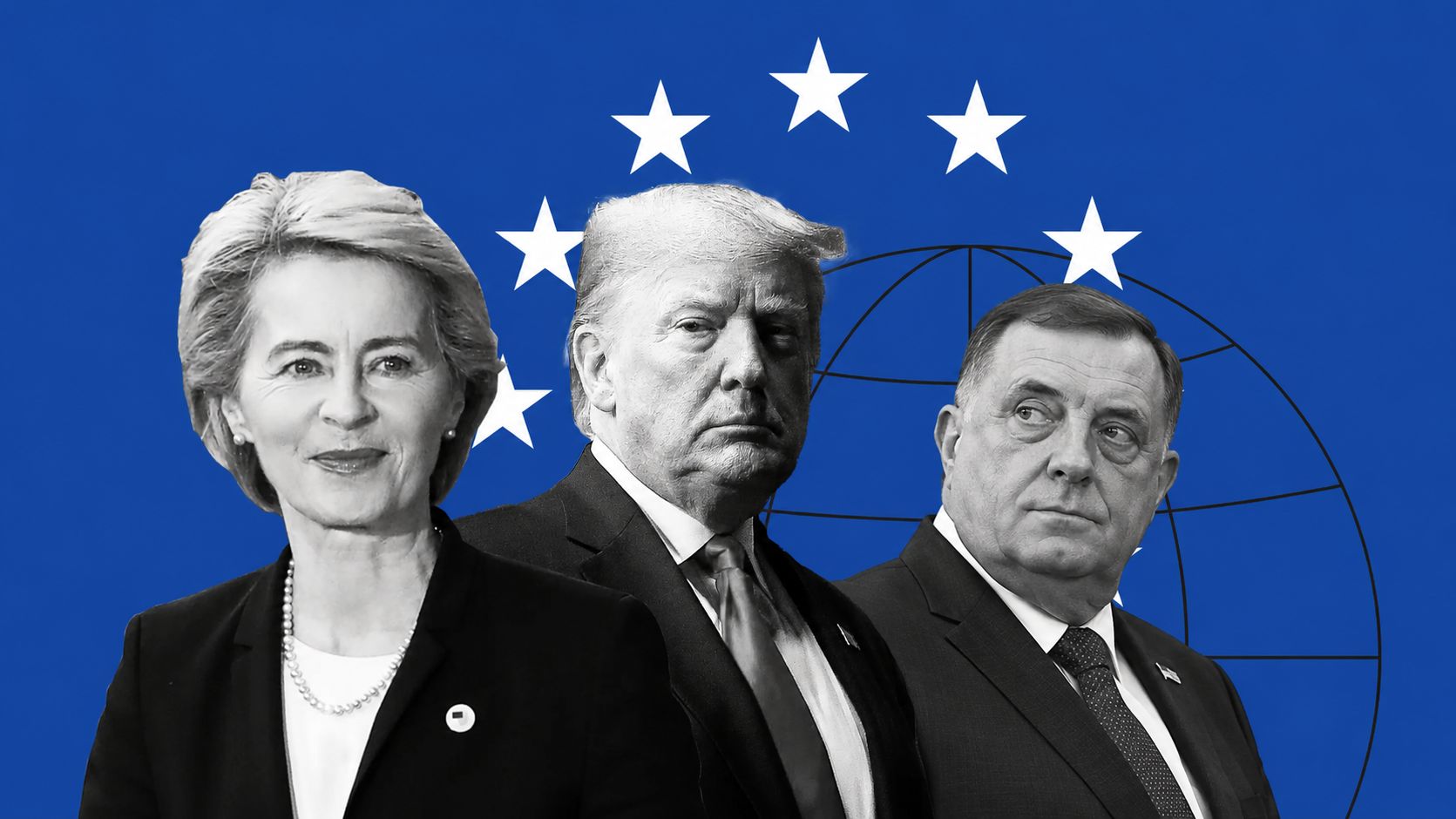

There is something profoundly symbolic in the fact that the new geopolitical battle between Washington and Brussels is once again being fought over Bosnia and Herzegovina. The history of the Balkans has often been the history of great powers demonstrating their own ambitions, frustrations, and strategic messages in small spaces. But what we are witnessing today may be even more dangerous: Bosnia and Herzegovina is becoming an experimental terrain for redefining relations between Donald Trump's America and the European Union.
Telling words
In that sense, the words of former High Representative Wolfgang Petritsch are not just another diplomatic lamentation of a retired European bureaucrat. They are an alarm. Petritsch openly claims that "since Donald Trump's arrival, the European Union has become Washington's enemy" and that the USA is trying to weaken Europe precisely through Bosnia and Herzegovina.
At first glance, such a claim sounds exaggerated. America has for decades been the main protector of European security architecture, guarantor of the Dayton Agreement, and a key factor of stability in the Balkans. However, Trump's America is not the America of George Bush, Bill Clinton, Barack Obama, or even Joe Biden. Trump does not view international relations through ideological alliances, but through transactions of power. He sees the European Union as an economic competitor that exploits American military protection, rather than as a "civilizational partner."
This is precisely why BiH becomes a perfect pressure point. Bosnia and Herzegovina is the weakest link in the European space: institutionally fragile, politically divided, economically dependent, and geopolitically unfinished. If you want to send a message to Europe that it is incapable of managing its own backyard, there is no better place than Sarajevo. Great powers rarely directly destroy their opponents; much more often they demonstrate their powerlessness in peripheral territories. The British Empire did this to the Ottomans in the Balkans in the 19th century, the Soviet Union did it to Americans in Africa and Latin America during the Cold War, and today Trump's America may be doing the same to the European Union—in Bosnia.
This was demonstrated when, behind the European Union's back, the United States took over the South Interconnection project, secured the job for its own people, and forced domestic politicians from all three peoples to sign what was demanded of them, while the EU only sent confused and weak warnings that the entire procedure was not in accordance with European standards.
It was demonstrated when, as reliable sources say, the United States forced Christian Schmidt to withdraw from his position as High Representative. Schmidt was a symbol of European management of Bosnia and Herzegovina. A German, a man of the CDU and CSU, politically deeply tied to the European establishment. His resignation was received with considerable shock among European representatives, while America was already considering its favorite for a successor.
Europe's move
Will EU representatives in the PIC have the courage to stand up to the USA and block the entire process? Given the divisions within the EU and its indecision regarding BiH, the probability of that happening is low. The Americans sense European weakness, and Donald Trump has proven throughout his career to be a master at attacking an opponent and finishing him off as soon as he senses even the slightest sign of weakness. That is precisely the case with European influence in BiH.
Petritsch warns of exactly this when he says there is a US strategy to find a High Representative acceptable to Washington, Moscow, and the Republic of Srpska. In other words, the European Union is being removed from the entire process, but also, which is particularly damaging, the Bosniak political factor.
Therefore, it sounded tragicomic when President Sabina Ćudić stated that BiH's goal is not the USA but the European Union, which was in a way also an admission by her and the Bosniak representation in power that America no longer particularly cares about their opinion.
The European Union treats Bosnia and Herzegovina without a unified and clear policy, through a series of procedures, conditions, and negotiations with our country on the path toward membership and the improvement of the quality of institutions and systems, which is progressing too slowly and laboriously. Trump's America has no interest in such a project. It doesn't care about BiH's internal structure. What matters to it is that there exists a political structure through which it can achieve energy, security, and business interests—even if that means maintaining permanent instability. In other words, getting the job done.
Until recently isolated from the West, Milorad Dodik, a man who was on the verge of prison, becomes the ideal symbol of a new era. A man who has real power, albeit over half of BiH, and with whom business "can be arranged," with a reconciliation of Russian and American interests while bypassing the EU. Once, the West had a clear hierarchy: America leads, Europe follows, Russia is contained. Today those lines are becoming blurred.
And that may be perhaps the most important lesson Trump is teaching Europe through Bosnia and Herzegovina: that the European Union has no real sovereignty without American support.
Because every time Brussels tries to pursue an independent policy in the Balkans, a few phone calls from Washington, one energy maneuver, or a change in the OHR are enough to show how fragile European power actually is.
Bosnia and Herzegovina thus once again becomes what it has often been throughout history: not a subject of international politics, but a board on which others demonstrate their own strength. And perhaps the greatest irony lies in the fact that all of this is happening precisely at the moment when Europe is trying to prove that it can be a geopolitical force.
If it cannot control processes in Sarajevo, how will it then control its own future?